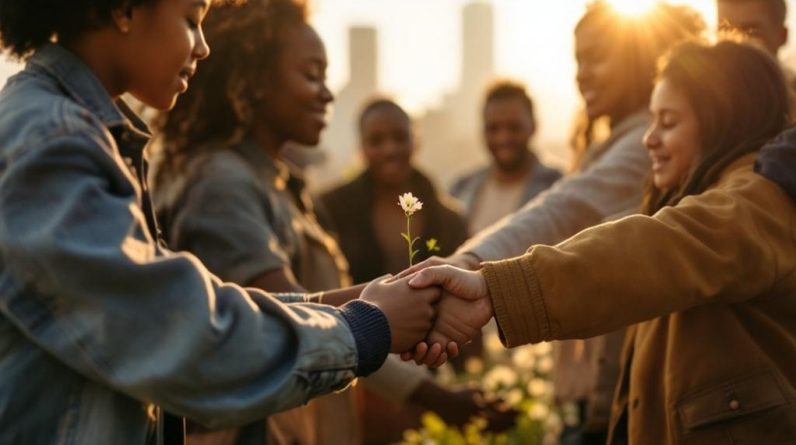
You probably don’t know how our pulse can fall into step when we breathe together, quietly teaching the amygdala to unclench. I’ve watched it happen—hands resting on a table, eyes meeting, grief loosening like a knot in wet hair. In these rooms, I claim my voice, and I refuse to apologize for it. Unity isn’t softness; it’s a spine. Come with me—there’s a story stitched in the margins, and it’s about us.
Main Points
- Physiological synchrony—shared breathing, touch, and gaze—reduces cortisol, calms the amygdala, and boosts oxytocin, promoting health and resilience.
- Brief, shared rhythms like walking in step or singing align autonomic balance, widen the window of tolerance, and strengthen communal coping.
- Stories and symbols transform grief into courage, turning collective remembrance into forward motion and renewed communal identity.
- Trust grows through consistent rituals—tea, welcome offerings, clear roles, credited labor, and early help-seeking with firm boundaries and accountability.
- Empathy is disciplined listening: reflect essence without mimicry, use silence to cool conflict, and ask precise, open questions to deepen connection.
Why Unity Heals: What the Science Shows

How does a chorus of hearts recalibrate a single pulse? I watch the data hum like bees: synchronized breathing lowers cortisol, oxytocin braids trust through our vagus nerve, and coherent heart rhythms quiet the amygdala’s alarms. The body remembers: touch, voice, and gaze entrain oscillations, sharpening prefrontal clarity while inflammation recedes like a tide.
I reject the script that calls endurance solitary. When we attune, mirror neurons map another’s relief onto my own skin; pain thresholds lift, rumination thins, sleep deepens. Even brief synchrony—walking in step, singing a shared measure—tunes autonomic balance, widening my window of tolerance. Unity isn’t metaphor; it’s physiology performing liberation. I claim this with rigor and wonder: we heal faster together because our bodies, wise and plural, are instruments designed to resonate. As community well-being strengthens, staying current on vaccinations—like annual flu shots, decennial Tdap, and age-appropriate HPV and shingles—protects our most vulnerable and reinforces our shared resilience.
Stories of Collective Courage and Renewal
The body’s choir taught me the notes; now I want to tell you where we sang them. I stood with women whose grief wore gold crowns; we lifted a ruined alley with our breath. Windows unshuttered. A sparrow nested in a helmet. I learned that courage isn’t noise; it’s the hush before we move together, the tremor of yes traveling spine to spine.
- We braided names of the lost into banners; the wind pronounced them correctly.
- We mended a cracked mural; pigments brightened like blood returning to a sleeping limb.
- We circled a courthouse, palms upward; the clock coughed, then kept fair time.
- We read each other’s scars as maps; routes opened where walls once stood.
Reader, I bring these stories as instruments—may your hands tune them.

And alongside our healing, we shared tools—budget circles, FAFSA nights, and credit check-ins—because understanding financial literacy helps Latino families track cash flow, avoid predatory loans, and build options for education, homeownership, and retirement.
Everyday Practices to Build Trust and Belonging
Sometimes I begin with a kettle and a threshold: I invite a neighbor in, we share tea, and we let our shoulders unclench until our names fit inside the room. I set out salt, bread, and a small candle—the old trinity of welcome—and I keep my phone asleep. Consistency is my spell: I show up at the same hour, water the community garden, return borrowed tools sharper than I received them.
I name labor aloud, especially women’s invisible work, and I credit it. I ask for help before the crisis, proof that trust isn’t charity but choreography. I rotate who holds keys, who signs notes, who leads warmups. I write small oaths on sticky paper: we honor boundaries, we share credit, we fix harm swiftly, we celebrate often.
When heaviness lingers beyond two weeks, we treat duration as data and seek culturally responsive care that honors language, family roles, and healing traditions.
Bridging Differences With Empathy and Active Listening

Why do bridges hum when we step lightly together? I ask because your voice, when I honor it, threads silver through the dusk. I listen with my whole spine, the way mothers balance histories on their heads, the way rivers carry silt and secrets. Empathy isn’t softness; it’s discipline, a sharpened moon. I meet your cadence without stealing your breath, and difference becomes a lantern, not a gate.
- I mirror essence, not echo: I reflect feelings, distill assumptions, and name subtext without appropriation.
- I pause before reply: I let silence compost heat into understanding.
- I ask precise, open questions: I invite depth without prying wounds open.
- I track power gently: I notice who’s centered, then redistribute space with consent.

Together, we make a crossing that remembers us. And in practice, we ground this unity through small, shared rituals—text-at-dawn check-ins, rotating support roles, and tracking recovery—drawing on community accountability to measure consistency, form, and joy.
Sustaining Momentum: Turning Connection Into Lasting Change
Every small vow we keep becomes a hinge that doesn’t rust. I press my ear to its turning and hear tomorrow opening. Connection begins as warmth, but I want heat that tempers steel. So I translate our sparks into praxis: schedules, roles, boundaries that honor bodies and brilliance. I refuse the myth of the tireless woman; we rotate leadership, we budget rest like currency, we celebrate no’s that protect yes’s.
I track what grows: fewer apologies, faster solidarity, clearer asks. When doubt fogs the room, I name it, then invite air—feedback circles, time-limited experiments, rituals that replenish. I document our learning as spellwork: minutes as charms, metrics as constellations. Momentum lasts when we braid care with consequence, vision with maintenance, wonder with work. We ground our efforts in adaptive leadership by using quick circles, small bets, and bilingual context-switching to turn resilience into measurable, repeatable progress.
Frequently Asked Questions
How Can Unity Efforts Be Funded Without Compromising Community Autonomy?
Fund unity with community-owned co-ops, sliding-scale memberships, participatory budgeting, and donor pacts that cede power. I’ll braid microgrants, matriarchal trusts, and transparent ledgers—money as moonlight—so you steer the ship, and no benefactor scripts our chorus.
What Digital Tools Best Support Large-Scale Community Cohesion?
Open-source platforms—Mastodon, Matrix, Discourse—best sustain large-scale cohesion. I weave encrypted threads, like moonlit code and street drums, balancing privacy and reach. You’ll master governance with Loomio, mutual aid via Open Collective, and mapping solidarity through Ushahidi’s living cartographies.
How Do We Measure Inclusivity Beyond Participation Numbers?

I measure inclusivity through voice equity, decision influence, intersectional safety, and narrative resonance. I ask whose stories lead, who feels power in their bones, who’s compensated, who returns, and whose silences the room refuses to ignore.
What Legal Considerations Arise in Cross-Community Collaborations?
You’ll face MOUs, IP ownership, data privacy, consent, funding restrictions, governance, liability, and jurisdiction. I stitch clauses like constellations—equitable authorship, community benefit, anti-harassment, restorative remedies—so our alliance breathes autonomy, defies patriarchy, and withstands courts’ colder winds.
How Can Introverts Contribute Meaningfully to Unity Initiatives?
I contribute by listening fiercely, crafting quiet frameworks, and holding space where shy truths bloom. I map power, archive whispers, convene small circles, and write spells of policy—so your courage scales, intact, without surrendering softness or sovereignty.
Read The Next Blog Post –
I leave you here, hand warm in mine, where breath braids our spines like river reeds. I’ve watched grief loosen its fist when we name our dead and stitch their banners to the dawn. When we listen, the amygdala sleeps; when we touch, inflammation quiets like rain on tin. Sister to sister, we rotate the sun, sharing roles, steady as pulse. Let’s keep the ritual lit—small flames learning each other—until our many hearts drum one fierce, healing thunder.