


You might think two tongues tangle the sacred, but I’ve learned they braid it tighter. When I whisper Our Father and hear Padre nuestro answer, my grandmother’s rosary beads click in my pocket like tiny bells. Forgiveness and perdón meet in the middle, and a child’s Amen lifts the dust. I’ve watched silence become a third language at the kitchen table. If you’ll sit with me a moment, I’ll show you how we keep that music alive.
Main Points
- Pray side-by-side texts (Our Father, Hail Mary, Gloria) in English and Spanish to create resonance, not mere repetition.
- Use mirrored calls and responses so both languages share leadership and maintain a unified rhythm.
- Keep words un-translated during prayer; focus on shared meaning—trespasses/ofensas sound as one chord.
- Guide pronunciation simply: vowels as steady stones, ñ distinct, double rr rolled, pausing for clarity.
- Build a routine: pocket bilingual resources, rotate leaders, schedule language braiding, and include silence as a third tongue.
Why Praying in Two Languages Deepens Connection
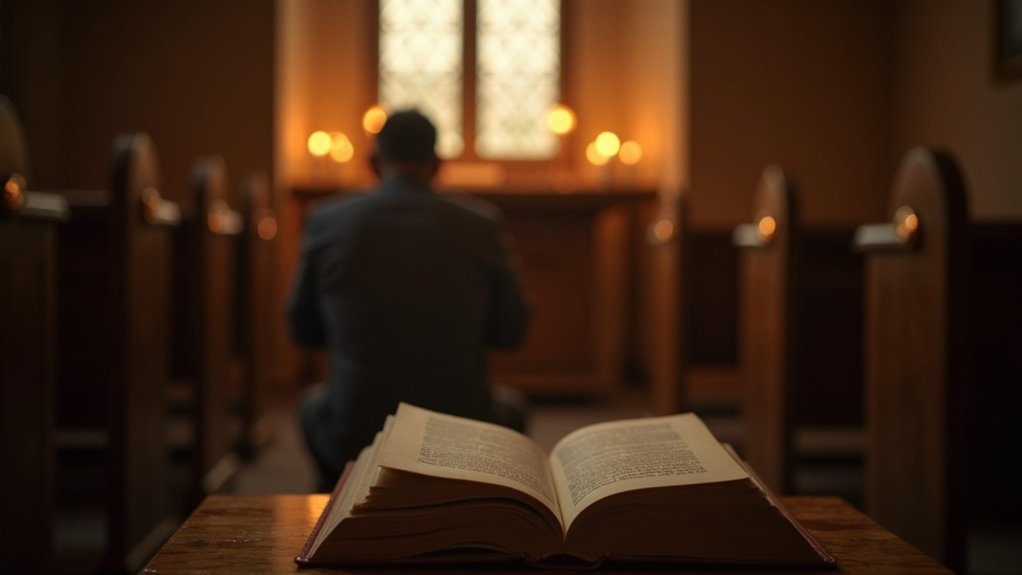
How else can I tell you that two tongues can braid a single prayer like my grandmother’s silver hair and my mother’s dark braid? When I pray in English and Spanish, I feel the prayer inhale twice and exhale once, lungs of different histories sharing one breath. Each word carries a distinct gravity: mercy falls like rain in one language, like morning light in the other. You hear resonance, not repetition—shades of meaning gathering like doves on a wire.
I learned cadence at the kitchen table, where spices rose like incense and stories kept watch. In bilingual prayer, memory becomes architecture: a house with two doors, one God within. The heart crosses thresholds without translation, and devotion turns fluent—precise, tender, whole.
Side-by-Side Texts of Beloved Christian Prayers
So I open the house with two doors and invite you in, setting the prayers on the table like twin candles—Our Father, Hail Mary, Gloria—English beside Spanish, flame answering flame. I trace each line with my finger, hearing my abuela’s voice braid with my mother’s, then mine: Padre nuestro/Our Father, thy kingdom come/venga tu Reino. The syllables mirror like river and reflection, each carrying the other’s weight without drowning.
I don’t translate; I listen for resonance. Forgive us our trespasses/perdona nuestras ofensas—two notes of one chord. In the Hail Mary, gracia and grace sip from the same cup. The Gloria opens a window; gloria and glory ring like bells from opposite towers. Side by side, the prayers teach precision, humility, and breadth.
Tips for Inclusive Worship in Mixed-Language Settings

Sometimes I stand at the church door like a translator of weather, feeling both languages move through me as one breeze. I welcome you by name, then invite the room to breathe together—shared tempo before shared text. I craft liturgy with deliberate symmetry: brief calls, mirrored responses, no one stranded. I signal transitions aloud and on the page, so meaning doesn’t flicker and vanish.
I weave elders’ cadences with children’s certainty—stories that walk on two feet, neither limping. I choose songs with echoing phrases, rotate which language starts, and honor silence as a third tongue. I train lectors to pause at thresholds of sense. I position microphones like lanterns. Most of all, I measure success by faces lifted, not volume—communion over performance.
Pronunciation and Participation Guides for Families

Already, I hear the vowels like river stones in my palm, and I pass them to you one by one—á bright as a candle, e soft as evening, i a thin silver thread. Let your mouth shape o like a prayerful bowl, u like a quiet flute. I guide your tongue: place it gently for ñ, let r ripple—single tap for caro, rolling thunder for carro. Breathe before Dios, release after Señor; clarity lives in the pause.
We stand in a circle where ancestors lean close. I name syllables, you echo: pa-dre nues-tro, ho-y, pa-z. We align stress: bendición, co-ra-zón. I invite children to lead refrains; adults anchor tempo. We use hand signs for cadence, eyes for entrances. Together, precision becomes hospitality, and every voice finds home.
Resources for Building a Bilingual Prayer Routine
The small tools matter, like candles we can carry from room to room: a pocket psalter in English and Spanish, an app that whispers the Angelus at noon, a playlist where abuela’s hymn meets a child’s clear chorus. I build a cadence: morning Lauds in English, evening Completas en español, Sundays braided. I keep a bilingual missal, a modest rosary guide with parallel texts, and a calendar marking saints in both tongues. I record elders pronouncing Gloria, niños echoing Amen, then replay to refine rhythm. I set reminders, but I let scent—cafecito, beeswax—anchor recall. You can, too. Rotate leaders, translate intentions aloud, and journal petitions in both languages. Over time, muscle memory takes the lead, and prayer walks fluently between worlds.
Frequently Asked Questions
How Do Bilingual Prayers Impact Children’s Language Development and Cognition?

They enrich vocabulary, executive control, and metalinguistic awareness. I’ve watched children weave two tongues like twin rivers, remembering elders’ cadences; you, too, can guide them—rhythm, repetition, and code-switching sharpen attention, memory, and flexible thinking across generations and disciplines.
Are There Cultural Sensitivities When Translating Sacred Terms Across Dialects?
Yes—each dialect cradles sacred terms differently. I tread gently, ask elders, map etymologies, honor connotations. I test resonance aloud, avoid false cognates, footnote ambiguities, and preserve silence where holiness lives, so you inherit meaning without losing ancestral breath.
What Copyright Rules Apply to Printing Bilingual Prayer Booklets?
You’ll need permission for copyrighted translations and modern texts; I secure licenses, credit authors, respect moral rights, and check public-domain status. I navigate fair use cautiously, like threading ancestral needles, stitching prayers across time without tearing lineage.
How Can Interfaith Families Adapt Bilingual Christian Prayers Respectfully?
Honor each tradition’s core names, ask elders’ consent, keep sacred phrases intact, and weave shared values. I balance languages line-by-line, annotate origins, invite alternating voices, and hold silence—so adaptation becomes reverence, not collage, a living, intergenerational covenant.
Which Bible Translations Pair Best for Bilingual Prayer Reflection?
I pair NRSV or ESV with Reina-Valera 1960; for inclusive nuance, NRSVUE with Nueva Biblia de las Américas. I hear abuela’s candles whisper, generations echoing verse-for-verse, doctrine precise, cadence aligned, hearts crossing thresholds where language becomes one flame.
Read The Next Blog Post –

I leave you with this: when I whisper Padre nuestro beside Our Father, my grandmother’s rosary warms in my palm and my child’s breath syncs with mine. Nearly 41 million people in the U.S. speak Spanish at home, which means our pews already hum in two keys. Let’s let them. I’ll bring the candles; you bring the pauses. Together we’ll braid grace and gloria, forgiveness and perdón, until silence becomes our third tongue, steady as a heartbeat, bright as morning.


